
Good laminate starts with the room, not the sample board. Match three things to the space: a wear rating for its foot traffic, the maker’s written water terms, and a flat, dry subfloor. Then check the carton. Since March 22, 2019, regulated composite wood products must carry a “TSCA Title VI compliant” label.
Laminate is a printed wood or stone image under a clear wear layer on a fiberboard core. It shines in living rooms, bedrooms and hallways, where scratches matter more than spills. It fails early for two predictable reasons: water that reaches the core through seams or from below, and installs that skip the subfloor prep and expansion gaps the warranty requires.
What are the layers of a laminate plank?
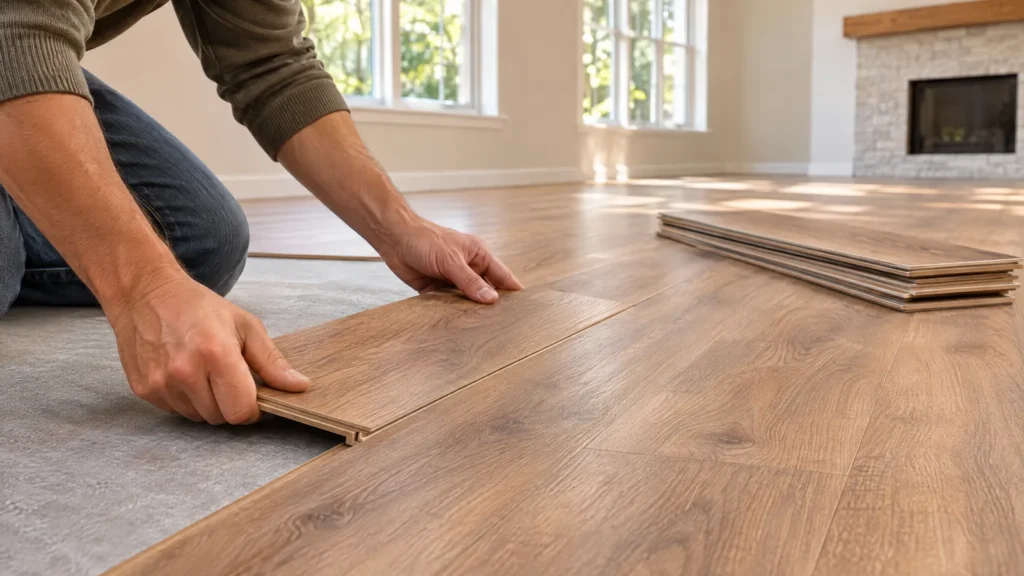
Most residential laminate is a floating floor: the planks lock to each other instead of being nailed or glued down. Knowing what each layer does tells you which questions to ask before you buy.
| Layer | What it does | What to ask before buying |
|---|---|---|
| Wear layer | Clear top coat that resists scratches, scuffs and stains | How the maker rates it for foot traffic and what the finish warranty covers |
| Decorative layer | Printed image of wood grain or stone | How often the pattern repeats across a carton |
| Core | Usually high-density fiberboard that gives the plank its stiffness | What the maker says about water at the seams and edges |
| Backing | Bottom layer that adds stability and some moisture resistance | Whether a separate underlayment or vapor barrier is still required |
You will see a few terms on nearly every carton and spec sheet. These come from manufacturer and industry specs, not from a federal standard, so compare products within one brand family when you can.
- AC rating. A durability class for how much foot traffic and abrasion the wear layer is built for. A higher class is meant for heavier use, but it says nothing about water resistance.
- Thickness. Thicker planks tend to feel more solid and sound less hollow, but no thickness makes up for a subfloor that is not flat.
- Click-lock or glueless. Planks that snap together along their edges, which is why laminate is popular with DIY installers.
- Underlayment. A foam or felt pad under the planks that smooths small flaws and reduces noise. Some products have it pre-attached.
- Expansion gap. A space left at walls and fixed objects so the floor can move with seasonal humidity, hidden under baseboard or trim.
Which rooms suit laminate, and how does it compare with other floors?
Each floor type trades cost, water tolerance and feel differently. This comparison is general, so check specific products against their own written warranty.
| Floor type | What you gain | What you give up | Watch for |
|---|---|---|---|
| Laminate | Hard, scratch-resistant surface and a realistic wood look at a modest price | A fiberboard core that can swell if water sits at seams | Wet-area limits in the warranty |
| Luxury vinyl plank | A plastic-based core that most product lines say handles moisture better than fiberboard | A softer top that can dent under heavy furniture | Waterproof labels that rest on narrow warranty terms |
| Solid hardwood | Can be sanded and refinished more than once | Higher material cost and sensitivity to water and humidity | Humidity swings that cause gaps or cupping |
| Ceramic or porcelain tile | Tolerates water in kitchens, baths and entries | Hard and cold underfoot, with a labor-heavy install | Cracked tiles over an uneven or flexing subfloor |
For full bathrooms and laundry rooms, read the wet-area section of the warranty before you assume laminate is allowed at all. If you are planning a bath project, our guide to bathroom remodeling contracts and safety covers the other decisions that come with it.
Finish matters for safety as well as looks. A glossy plank, a loose transition strip or an area rug with no grip pad can become a slip or trip point. If an older adult lives in the home, a textured finish and thresholds that sit flat are worth prioritizing, and our guide to fall-safe home upgrades lists other quick fixes.

Is laminate flooring waterproof?
Some newer laminate lines are marketed as waterproof or highly water-resistant, and the claim on the box and the coverage in the warranty can be two different promises. A water-resistant claim often covers topical spills wiped up within a set time, not water that seeps through seams or rises from a wet subfloor.
Before you put laminate in a kitchen, bath or entry, read three things in the written warranty: its definition of water damage, any time limit on spills, and whether the maker requires sealed edges or a moisture barrier. If those terms are vague or missing, treat the waterproof claim as advertising, and ask for the warranty before you buy, not after the install.
Fix any water source before new flooring goes down. A slow leak under a sink or behind a toilet can ruin a floating floor from below, and our guide to finding your shutoff valve and stopping small leaks covers how to spot and stop one.
What should you know about formaldehyde and laminate?
Laminate cores are composite wood, and composite wood is one of the main indoor sources of formaldehyde. The EPA says the most significant indoor sources of formaldehyde are likely to be pressed wood products, and that levels can be greater than 0.3 parts per million in homes with significant amounts of new pressed wood, while older homes without urea-formaldehyde foam insulation generally average well below 0.1 ppm.
Federal emission standards cover the products these cores are made from. The EPA’s consumer FAQ says its formaldehyde emission standards for hardwood plywood, medium-density fiberboard and particleboard came into force beginning June 1, 2018, that finished goods containing those products are also covered, and that regulated products must be labeled “TSCA Title VI compliant” after March 22, 2019. Ask the retailer whether the product you are considering carries that label.
After installation, the EPA suggests increasing ventilation, particularly after bringing new sources of formaldehyde into the home, and using air conditioning and dehumidifiers to keep temperature moderate and humidity down. Humidity control also helps the floor itself, since laminate moves with seasonal moisture.
How do you estimate how much laminate to buy?
Measure each room, multiply length by width, and add an overage for cuts and waste. Your installer or the product guide will say how much overage to plan for, since it depends on the room shape and the plank pattern.
Here is the arithmetic with hypothetical numbers. Say a room measures 12 by 15 feet, which is 180 square feet. With a 10 percent overage, you need 198 square feet. If each carton covers 20 square feet, 198 divided by 20 is 9.9, so you buy 10 cartons. Buy them from the same production lot if you can, so color and texture match, and keep a spare carton for future repairs.
What should a laminate quote include?
A low per-square-foot price can leave out the very work that decides how the floor performs. We have not found a government source for typical laminate prices, so judge bids by what they include. Ask each bidder to price these lines separately:
| Line item | Why it changes the total |
|---|---|
| Removal and disposal | Old flooring has to go somewhere, and surprises underneath need a plan |
| Subfloor prep | Leveling, patching and moisture testing decide whether the warranty holds |
| Underlayment or vapor barrier | Some products require one, some have it pre-attached |
| Trim, transitions, thresholds and stairs | Easy to miss in a quick estimate |
| Cabinets and islands | Setting heavy fixtures on a floating floor can pin it and lead to buckling |
| Acclimation and expansion gaps | The maker’s guide sets both, and skipping them can put the warranty at risk |
Many warranties depend on following the maker’s guide for acclimation, subfloor flatness, moisture barriers and expansion gaps. Ask the installer to confirm in writing that the job will follow that guide.
What if you are removing an older floor?
If you are not sure what is under the current floor, ask before anyone tears it out. Floating laminate over an existing sound floor is sometimes possible, but the manufacturer’s guide decides what it can go over.
Do it yourself or call a pro?
Click-lock laminate is one of the friendlier floors for a first DIY job. The catch is that you take on the prep, the cutting and the warranty risk. If you go it alone, have this on hand before the first plank:
- The maker’s installation guide and warranty, printed or saved
- Tape measure, pencil and a square
- A saw or laminate cutter suited to the plank
- Tapping block and pull bar
- Spacers for the expansion gap
- Underlayment or vapor barrier, if the product requires it
- Knee pads and safety glasses
Then weigh the three paths honestly.
| Choice | What you gain | What you give up | When it is the worse move |
|---|---|---|---|
| DIY install | Labor savings and control of the schedule | Your time, tool costs and the risk that mistakes void the warranty | When the subfloor has water damage or is out of level, or the warranty requires a professional |
| Professional install | Experience with prep, door jambs and transitions, and sometimes a workmanship warranty | A higher total and the job of vetting the contractor | When the bid skips prep or the maker’s installation rules |
| Wait a season | Time to save and compare products | More wear on a damaged floor and longer exposure to trip hazards | When there is an active leak or a lifting floor someone could trip on |
If this is your first flooring job, our guide to starting DIY projects safely covers how to judge whether a job fits your skills and tools.
Does new flooring count as a home improvement for taxes?
It can. IRS Publication 523 says improvements add to the value of your home, prolong its useful life or adapt it to new uses, and it lists flooring and wall-to-wall carpeting among its examples. Ordinary repairs and maintenance, such as fixing leaks or filling cracks, do not add to basis.
Say you bought a home for a hypothetical $320,000 and later paid $8,000 for laminate in the main living areas. Your basis rises to $328,000 before other adjustments, so any gain on a future sale is $8,000 smaller. Basis only lowers tax if your gain is larger than the home sale exclusion you qualify for, so keep the contract, invoice and proof of payment, and ask a tax professional how the rules apply to you.
Which contract terms protect you?
The FTC’s home improvement guidance says to consider only licensed and insured contractors, confirm the license with your state or county, and get multiple written estimates that describe the work, materials, completion date and price. Do not automatically pick the lowest bid, and ask for an explanation when prices are far apart.
The contract should list the contractor’s name, address, phone and license number, the estimated start and completion dates, and any promises made in conversation, with no blank spaces. If you signed at home, it should state your right to cancel within three business days. Do not pay the full amount up front, and hold the final payment until the work is done and you are satisfied.
How are flooring deals marketed?
I have spent 18 years in finance and insurance performance marketing, and flooring offers follow a familiar pattern: a low per-square-foot headline or a free in-home measure, with the costs that change the final number arriving later in the visit.
Three claims deserve a discount: installed prices that skip prep, removal and trim, waterproof promises without the written warranty attached, and financing that makes the job look affordable only by the month. The FTC says never to agree to contractor-arranged financing without shopping around and comparing loan terms. If you are weighing flooring against other projects, our guide to renovations that protect your home’s value compares the options.
What should you do before you buy laminate flooring?
- Match the product to the room. Pull the installation guide and warranty, and confirm the rooms you plan to cover are allowed.
- Check the subfloor and water sources. Look for soft spots, stains and uneven areas, and fix any leak first.
- Ask what is under the old floor. In an older home, do not sand or scrape old resilient flooring until you know it is asbestos-free.
- Check the label. Ask whether the product is labeled TSCA Title VI compliant.
- Get itemized written estimates. Compare prep, removal, underlayment, trim and transitions line by line.
- Read the contract and pay in stages. Look for dates, the cancellation notice and no blank spaces.
- File the paperwork. Keep the contract and invoices with your home records.
Frequently asked questions
What is the most important thing to check when choosing laminate?
Check whether the manufacturer’s written warranty allows the product in the room you plan to cover, then match the wear rating to the foot traffic. A high wear rating says nothing about water resistance.
Can laminate flooring go in a bathroom or kitchen?
Only if the written warranty allows it. Many water-resistant claims cover topical spills wiped up within a set time, not water that seeps through seams or rises from below.
Does laminate flooring contain formaldehyde?
Its core is composite wood, which the EPA names as a major indoor formaldehyde source. EPA emission standards for those wood products took effect beginning June 1, 2018, and regulated products must be labeled TSCA Title VI compliant.
How much extra laminate should I buy?
Add the overage your installer or product guide recommends for cuts and waste. In the hypothetical example above, a 180 square foot room with a 10 percent overage needs 198 square feet, or 10 cartons of 20 square feet.
Can I install laminate over my old floor?
Sometimes, but the manufacturer’s guide decides what it can go over. In an older home, the EPA says not to sand or try to level asbestos flooring or its backing, so find out what the old floor is first.
Does new flooring add to my home’s basis?
It can. IRS Publication 523 lists flooring among improvements that add to basis, while ordinary repairs do not, so keep your contract and invoices.