
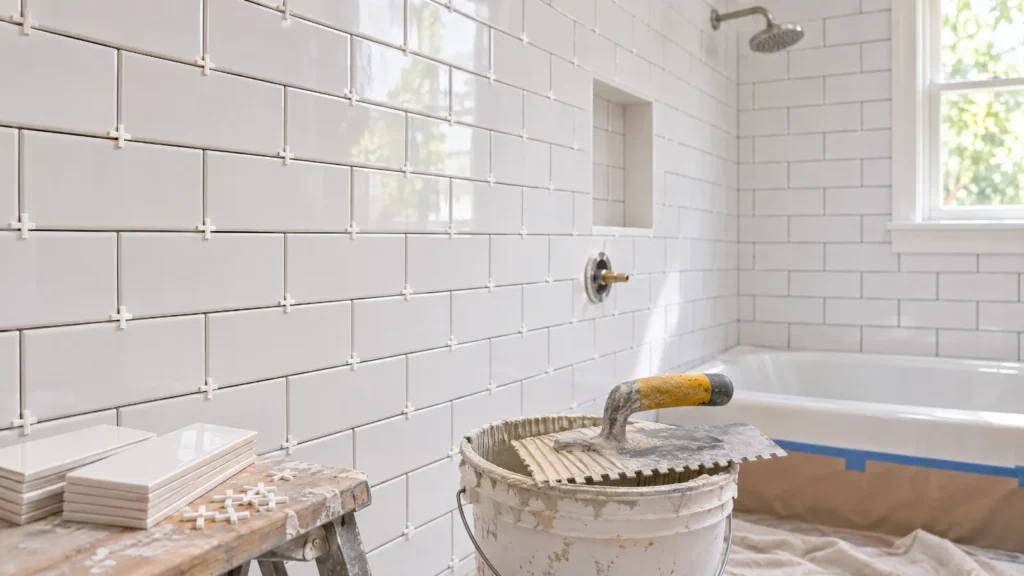
A bathroom remodel goes best when a licensed, insured contractor works under a detailed written contract, you pay in stages that follow finished work, and the plan builds in water, shock and fall safety. For a range check, the median reported spending on bathroom remodels done from 2021 to 2023 was $5,000, according to the Census Bureau’s 2023 American Housing Survey.
That median blends new faucets with full gut jobs, so your bids may land far from it. Winter tends to expose a bathroom’s weak spots: the mirror that stays fogged, the paint that peels over the shower. A bathroom crams plumbing, wiring, ventilation and wet floors into one small room, which is why the contract and the order of work matter more here than almost anywhere else in the house.
What should a bathroom remodel scope cover?
Write a one-page scope before you call anyone. List what stays, what gets replaced and what moves, so every contractor prices the same job. Most projects fall into one of three levels.
| Level | Typical work | What you gain | What you give up |
|---|---|---|---|
| Refresh | Paint, vanity top, faucet, mirror, lighting, grab bars | Quick results, little downtime | Old supply lines and subfloor stay hidden |
| Replace in place | New tub or shower, toilet, vanity, tile and fan in the same spots | A new room without moving drains | One to several weeks without that bathroom |
| Layout change | Moving the toilet, shower or walls; new circuits | A room that fits how you live | Permits, inspections, more trades and the highest cost |
Before you settle on a refresh, have a contractor or home inspector press on the floor around the toilet and tub for soft spots and look over the visible plumbing. Rot found after demolition moves money from tile to framing. Better to find it before you sign. If the floor needs replacing after a leak, our guide to laminate ratings and water risk explains what to check first.
Only one national figure here is sourced, the Census median, so there is no honest low, typical and high table to print. What follows is what moves your bid instead.
| What drives the cost | Keeps it lower | Pushes it higher |
|---|---|---|
| Layout | Toilet, tub and sink stay in place | Moving drains, the shower or walls |
| What is under the floor | A solid subfloor | Rot or water damage found at demolition |
| Tile and fixtures | Picks within the allowance | Upgrades past the allowance |
| Electrical | Existing protected outlets and fan circuit | New circuits, heated floors, a relocated fan |
| Accessibility | Grab bar blocking added while walls are open | A curbless shower that needs floor work |
| House age | Built after 1978 | Lead-safe work rules, old supply lines |
How do you plan for moisture and mold?
Ventilation is the detail most worth getting right, because it decides whether the new room stays dry. The EPA’s brief guide to mold and moisture says to run the bathroom fan or open a window when you shower, and to keep indoor relative humidity below 60 percent, ideally between 30 and 50 percent.
If demolition uncovers water damage, the same guide says to dry wet materials within 24 to 48 hours, since mold often will not grow if you do. A patch of about 10 square feet or less is usually yours to handle. The EPA suggests considering a professional when mold covers more than that or when there has been significant water damage.
Ask the contractor which fan they plan to install, where it vents and how it switches on. A fan nobody runs, or one too weak for the room, will not dry out a bathroom no matter how good the tile looks.

How do fixture choices affect water use?
The toilet matters most. According to the EPA’s WaterSense toilet page, toilets account for nearly 30 percent of an average home’s indoor water use. The federal standard is 1.6 gallons per flush, and WaterSense-labeled toilets use no more than 1.28 gallons, 20 percent less.
Older toilets can use as much as 6 gallons a flush. The EPA estimates that replacing older toilets with WaterSense models can save a household roughly 13,000 gallons a year and more than $170 a year in water costs. What you save depends on your water rates and how old the current toilet is.
What electrical safety belongs in the plan?
Water and electricity share a small room here, so outlet protection matters. A CPSC fact sheet, What Is a GFCI?, explains that a ground fault circuit interrupter cuts power almost instantly when it detects a ground fault, to protect people from severe or fatal shocks. It notes the National Electrical Code has required GFCIs in bathrooms since 1975, generally for new construction and major renovations.
New circuits, a heated floor or a moved fan are work for a licensed electrician, and your building department decides whether they need a permit.
How can a remodel lower fall risk?
Wet floors next to hard surfaces make the bathroom a common place to slip. The CDC reports that falls among adults 65 and older caused over 43,000 deaths in 2024 and are the leading cause of injury death for that age group. Emergency departments recorded about 4.5 million visits for older adult falls that year.
Our list of quick senior safety upgrades covers smaller changes that do not need a remodel at all.
What if the house was built before 1978?
The EPA’s Renovation, Repair and Painting Rule covers paid work that disturbs paint in housing built before 1978, when the work disturbs more than six square feet of painted surface per room inside. Covered work must be done by an EPA-certified firm trained in lead-safe practices. Pulling out a vanity, a medicine cabinet and old trim can pass that mark, so ask to see the firm’s certification before you sign.
Which bathroom jobs can you do yourself?
A refresh offers a few fair weekend jobs: painting, swapping a mirror or light fixture of the same kind on an existing box, recaulking the tub and replacing a toilet flapper. If that is your plan, the kit is short.
- Bathroom-rated paint, an angled brush, a small roller and painter’s tape
- Tub and tile caulk, a caulk gun, a plastic scraper and rubbing alcohol for cleaning the joint
- A replacement flapper or fill valve matched to your toilet
- A stud finder that also detects wiring, for anything you hang
- A non-contact voltage tester if you change a light fixture
- Safety glasses, gloves and a sturdy step stool
How do you hire a bathroom contractor?
The FTC’s home improvement scam guidance reads like a checklist written for bathrooms, where plumbing and wiring mistakes get expensive once the tile is up.
- Consider only licensed and insured contractors. Confirm the license with your state or county and ask for proof of insurance.
- Check reputation. Ask people you trust, check with consumer protection officials for complaints, and search the company name with words like complaint or review.
- Get several written estimates. Each should describe the work, materials, completion date and price.
- Do not default to the lowest bid. The FTC says to ask why when bids differ widely. Tile and fixture allowances often explain the gap, and our cost estimator worksheet shows how to line bids up.
- Settle permits in writing. The FTC lists a contractor who asks you to get the required permits as a warning sign. Our guide on permit rules for remodels covers what to ask your building department.
Get a written contract even if your state does not require one. The FTC says it should include the contractor’s name, address, phone and license number, estimated start and finish dates, any spoken promises about scope and cost, your right to cancel within three business days if you signed at home, and no blank spaces.
How should you structure the payments?
The FTC says not to pay the full amount up front, notes that some states limit how much a contractor can collect as a down payment, and says to hold the final payment until the work is finished and you are satisfied. Tie every payment to work you can see.
Say your contract is $18,000. A milestone schedule might look like this. The percentages are an illustration, not a legal standard, so check your state’s deposit limit first.
| Milestone | Share | Amount |
|---|---|---|
| Signing deposit | 10% | $1,800 |
| Rough plumbing and electrical passed inspection | 30% | $5,400 |
| Tile, tub or shower and fixtures set | 40% | $7,200 |
| Punch list finished, final inspection passed | 20% | $3,600 |
| Total | 100% | $18,000 |
Holding back $3,600 until the end gives the contractor a reason to finish the small stuff. Paying the second draw only after inspection means you never pay for work sealed behind a wall before anyone has looked at it.
If you plan to borrow, shop the loan yourself. The FTC warns against taking contractor-arranged financing without comparing other lenders. Our guide to borrowing for a remodel compares the options and their risks.
How are bathroom remodeling offers sold?
Many bathroom ads exist to book an in-home appointment, and the price arrives after a long presentation. I have worked on the marketing side of home services, and the playbook rarely changes: a price that expires tonight, a monthly payment printed bigger than the total, financing presented as already arranged.
Each one pushes you to sign before you hold another written bid. A calm answer works fine: you will decide after you compare estimates. The three-day cancellation right for contracts signed at home is a backstop, not a reason to rush.
Which records should you keep?
Save the contract, change orders, permits, invoices and proof of payment. IRS Publication 523, written for 2025 returns, lists a bathroom addition, a water heater and filtration systems among improvements that can add to basis. Painting and fixing leaks generally count as repairs, unless they are part of an extensive remodel. How basis applies when you sell is a question for a tax professional.
What changes the plan for your bathroom?
An active leak changes everything, so fix it first. Water spreads into subfloor and framing, and the EPA says damp materials should be dried within 24 to 48 hours. Who uses the room matters next. An older adult or someone with limited mobility moves the priority to entry height, grab bar blocking and light.
Moving drains or adding circuits pulls permits, inspections and licensed trades into the schedule. A pre-1978 house brings lead-safe rules, and its old plumbing may need replacing once walls are open. And if this is your only bathroom, decide now where everyone will shower for the weeks the work takes.
Planning a kitchen too? Our kitchen planning and budget guide uses the same bid and allowance method.
Frequently asked questions
How much does a bathroom remodel cost?
It depends on scope, materials and region. The Census Bureau’s 2023 American Housing Survey reported a median of $5,000 for bathroom remodels done from 2021 to 2023, a figure that mixes small updates with full renovations. Written bids for your own scope are the number to plan around.
Do I need a permit for a bathroom remodel?
Your city or county decides. Moving plumbing, adding circuits or changing walls is the work most likely to need one. The contract should say who pulls the permit and when inspections happen.
How much should I pay a bathroom contractor up front?
The FTC says not to pay the full amount up front and notes that some states cap down payments. Tie payments to inspected milestones and hold the final payment until the work is finished to your satisfaction.
How do I keep a new bathroom from getting moldy?
The EPA says to run the bathroom fan or open a window while showering and to keep indoor humidity below 60 percent, ideally 30 to 50 percent. Fix leaks quickly and dry wet materials within 24 to 48 hours.
Which bathroom safety upgrades matter most for older adults?
The CDC says falls are the leading cause of injury death for adults 65 and older. Grab bars anchored to wall framing, a low shower entry, slip-resistant floors and bright lighting are common general measures; an occupational therapist can advise on specific needs.

Tier 1 Sources
- U.S. Census Bureau and HUD: 2023 American Housing Survey, Home Improvements
- EPA: A Brief Guide to Mold, Moisture and Your Home
- EPA WaterSense: Residential Toilets
- CPSC: What Is a GFCI? (fact sheet)
- CDC: Older Adult Falls
- EPA: Frequent Questions About the Renovation, Repair and Painting Rule
- FTC: How To Avoid a Home Improvement Scam
- IRS: Publication 523, Selling Your Home