
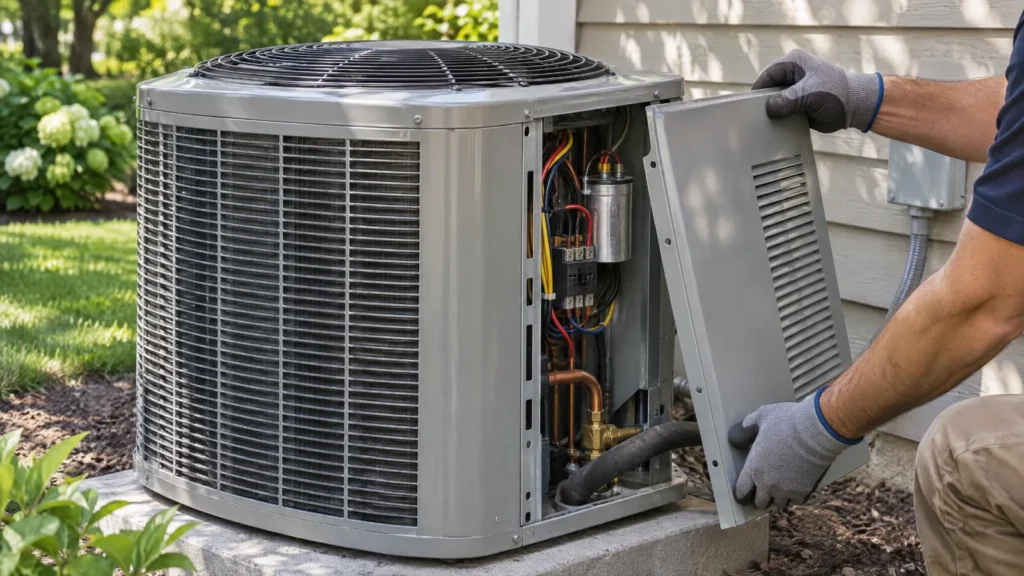
Most air conditioning trouble shows up in a few familiar ways: weak cooling, ice, water, noise or a bill that climbs for no clear reason. Many of those start with airflow, such as a dirty filter, blocked vents or a crowded outdoor unit, and you can check all three yourself. Refrigerant, electrical and compressor faults need a licensed technician.
If your system limped through last summer, the off-season is a calmer time to sort it out than the first hot week of next year. A cheap airflow problem and an expensive mechanical failure can feel the same from the couch, because both mean longer run times and a warmer house. Ruling out the simple causes first gives the technician better information, and it makes it harder for a routine service call to become a replacement pitch.
What are the common warning signs, and what do they point to?
| Symptom | What you can safely check | What belongs to a licensed technician |
|---|---|---|
| Weak airflow from vents | Filter condition, and furniture or rugs blocking vents and returns | Blower motor, duct damage, system sizing |
| Ice on the indoor coil or refrigerant lines | Turn cooling off, check for a dirty filter, and note whether ice returns | Refrigerant charge, leak testing, evaporator coil cleaning |
| Hissing or bubbling sounds | Note when and where it happens | Leak diagnosis and repair |
| Outdoor unit loud, hot or not running | With power off, clear leaves and trim plants back | Fan motor, capacitor, compressor and electrical work |
| Water near the indoor unit | Look for a full drain pan or a visibly blocked drain line | Deep clogs, condensate pumps, coil problems |
| Higher bills with no change in use | Compare bills month to month and check the filter | Full system diagnosis |
| Breaker trips or a burning smell | Turn the system off at the thermostat and leave it off | Electrical diagnosis before the system runs again |
Write down each symptom with the date, the time of day and the outdoor temperature. A technician who starts with a clear history spends less time guessing, and you have a record to compare against the written findings.
What can you safely check yourself?
The DOE’s air conditioner maintenance guide lists several homeowner tasks. It says to clean or replace filters every month or two during the cooling season, and more often if the system runs constantly, the house is dusty or you have pets.
- Clear the outdoor unit. DOE says outdoor condenser coils get dirty in dusty areas or near plants, and to trim foliage back at least two feet for airflow. Turn the power off at the disconnect before you work near it.
- Straighten bent fins. DOE notes that the thin aluminum fins on the coils can be combed back into shape with a fin comb.
- Keep the drain flowing. DOE suggests clearing the unit’s drain channels periodically with a stiff wire, since clogs can shut the unit off or cause water damage.
- Check room units. For window units, DOE says to inspect the seal between the unit and the window frame at the start of each cooling season.
DOE says cleaning the indoor evaporator coil is best left to a qualified contractor. Leave the sealed refrigerant loop and the electrical compartment alone too. If reaching the air handler means climbing into an attic or onto a ladder, have someone else do it or include it in the service call.
Water from a clogged condensate line can stain ceilings and soak floors before you see it. Our guide to stopping small water leaks covers what to do when water shows up where it should not.
When should you call a professional?
DOE says to hire a professional technician when the unit cannot cool your home adequately or needs more than routine upkeep. Call when you see ice that comes back after the filter is clean, hear hissing, find water you cannot trace to a simple clog, smell burning, or trip the breaker.
What should a good service visit include?
DOE lists what a technician should do on a service call. Use it as a checklist, and ask for the results in writing:
- Check the refrigerant charge and test for leaks
- Capture any refrigerant removed from the system rather than releasing it
- Measure airflow across the evaporator coil
- Inspect the electric terminals and tighten connections
- Check the thermostat’s accuracy
A written report that names the failed part, the test results and the repair price lets you get a second opinion on anything large. A verbal “the compressor is going” with a same-day replacement price does not.
What if your system uses R-22 refrigerant?
Older central air systems often run on R-22, also called HCFC-22. The EPA’s 2020 homeowner fact sheet says U.S. production and import of HCFC-22 ended on January 1, 2020, and that you may keep using it in your existing system for as long as necessary. Most air conditioners have a nameplate on the unit that identifies the refrigerant.
Servicing now relies on HCFC-22 that has been recovered and reclaimed. The EPA says equipment generally runs most efficiently on the refrigerant it was designed for, that a technician retrofitting a system should recover the remaining HCFC-22 and follow the manufacturer’s guidelines for the replacement refrigerant, and that R-22a is not an acceptable substitute because it is highly flammable.
For an R-22 system with a leak, ask for the leak to be found and fixed rather than repeatedly recharged, and ask for a written price on the repair next to a written price on replacement. The age of the system, the size of the leak and the cost of each option all change the answer.
Should you repair, replace or wait?
Each path trades cost today against risk later. Only a licensed technician who has inspected the system can tell you which parts have failed, so treat this table as a way to frame that conversation. It shows what drives the cost of each choice, not a price list.
| Option | What you gain | What you give up | When it is the worse move |
|---|---|---|---|
| Fix the simple cause (filter, debris, drain) | Low cost and a clearer diagnosis | Very little if the problem was airflow | When ice, hissing or electrical symptoms continue |
| Targeted repair | Keeps a working system running | Money spent on equipment that may still need replacing | When the same failure keeps coming back |
| Replace the system | New equipment, and possible state rebates | Large upfront cost and no federal credit for 2026 installs | When a written diagnosis shows a single, affordable repair |
| Wait until it fails | Cash stays available for now | An emergency purchase in hot weather with less time to compare bids | When there is ice, a leak or water near the indoor unit |
If a technician suggests switching to a ductless system instead of replacing central air, our guide to how mini-splits work and when they fit covers the trade-offs, including why sizing and placement decide the result.
The tax treatment differs too. Say you pay a hypothetical $400 to fix a leak, then $11,000 two years later to replace the central air system. IRS Publication 523 treats fixing leaks as a repair that does not add to your home’s basis, while central air conditioning is listed as an improvement that does. Only the $11,000 would go into basis, so keep that invoice and contract. These figures are illustrations, not typical prices.
Do federal credits or rebates help with a new system?
Not the federal credit, for 2026 installs. The IRS says the energy efficient home improvement credit (25C) is not allowed for property placed in service after December 31, 2025. Through 2025, the Form 5695 instructions gave heat pumps and heat pump water heaters a separate $2,000 annual limit, which no longer applies.
DOE Home Energy Rebates are separate and run only where a state program has launched. Under the federal HEEHR rules on ENERGY STAR’s program page, an ENERGY STAR certified heat pump for heating and cooling can receive up to $8,000, depending on household income. Rebates usually must be approved before you buy, so see our guide to state energy rebate rules before you sign a replacement contract.
Which contract and payment terms protect you?
The FTC’s home improvement guidance says to consider only licensed and insured contractors, confirm the license with your state or county, and get multiple written estimates that describe the work, materials, completion date and price. Ask for an explanation when one bid sits far from the others rather than picking the cheapest by default.
The written contract should include the contractor’s name, address, phone and license number, estimated start and completion dates, and any promises made in conversation, with no blank spaces. If you signed at home, it should state your right to cancel within three business days. Do not pay the full amount up front, and the FTC says never to agree to contractor-arranged financing without comparing loan terms; our guide to loans for home repairs compares the options. A replacement may also need a permit, which our permit guide explains how to check.
How are AC tune-up and replacement offers sold?
I have spent 18 years in finance and insurance performance marketing, and the AC offers that drive the most calls are usually a very cheap tune-up or a free inspection. That price exists to get a technician into the home, where a large repair or a full replacement is the profitable outcome.
The pressure points repeat: urgency about a part that is supposedly about to fail, a same-day discount that disappears when the technician leaves, financing framed as a monthly payment instead of a total, and tax credit claims that were never updated for 2026. A cheap tune-up can still lead to an honest diagnosis, so protect yourself with written findings and a second written estimate on anything large.
What should you do first if your AC is acting up?
- Check the filter. Replace it if it looks dirty, then watch whether airflow and cooling improve over a day or two.
- Clear the outdoor unit. With the power off, remove leaves and trim plants back at least two feet.
- Watch for ice. Turn cooling off if the coil or lines ice over, and call a technician if ice returns after the filter is clean.
- Log the symptoms. Note sounds, water and dates so the technician starts with facts.
- Check the nameplate. Find out whether the system uses R-22 before you weigh repair against replacement.
- Get findings in writing. Ask for test results and prices, and get a second estimate for any large repair or replacement.
- Plan for heat. If anyone in the home is 65 or older, line up an air-conditioned place to go if the system fails in hot weather.
Frequently asked questions
How often should I change my AC filter?
DOE says to clean or replace filters every month or two during the cooling season, and more often if the system runs constantly, the house is dusty or you have pets.
Why is my air conditioner freezing up?
Ice on the indoor coil or lines often traces to restricted airflow, such as a dirty filter, or to a refrigerant problem. Turn cooling off, check the filter, and call a licensed technician if the ice comes back.
Can I still use an air conditioner that runs on R-22?
Yes. The EPA says U.S. production and import of HCFC-22 ended January 1, 2020, but you may keep using it in an existing system for as long as necessary, serviced with recovered and reclaimed refrigerant.
What should an AC service visit include?
DOE says a technician should check the refrigerant charge and test for leaks, capture any refrigerant removed, measure airflow across the evaporator coil, check electric terminals and test the thermostat. Ask for the results in writing.
Is there a federal tax credit for a new air conditioner?
Not for equipment placed in service after December 31, 2025. The IRS says the 25C credit no longer applies, though a state HEEHR rebate may help with an ENERGY STAR heat pump where a program is open.
When is a broken AC an emergency?
When it fails in very hot weather and someone in the home is vulnerable to heat. The CDC advises adults 65 and older to stay in air-conditioned buildings as much as possible and not to rely on a fan as the main cooling source.

Tier 1 Sources
- U.S. Department of Energy: Air Conditioner Maintenance
- EPA: Residential Air Conditioning and the Phaseout of HCFC-22 (2020)
- CDC: Heat and Older Adults (Aged 65+)
- IRS: Publication 523, Selling Your Home
- IRS: FAQs on sections 25C, 25D and others under Public Law 119-21 (FS-2025-05)
- IRS: Instructions for Form 5695 (2025)
- ENERGY STAR: HEEHR program rebate amounts
- FTC: How to Avoid a Home Improvement Scam