
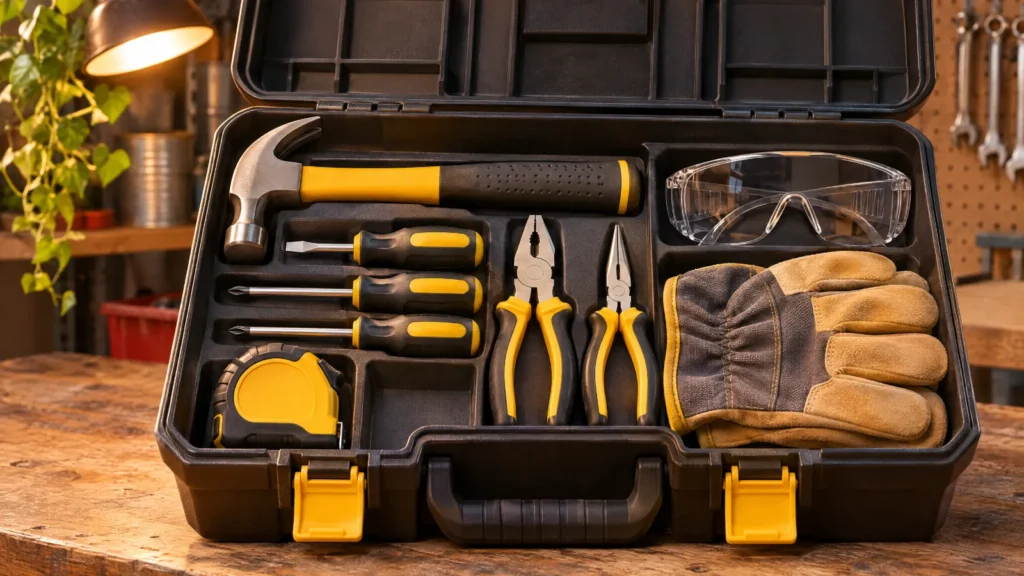
A useful home toolbox is short. A tape measure, screwdrivers, an adjustable wrench, pliers, a utility knife, a caulk gun, a flashlight, a stud finder and a plunger handle most small repairs. Add safety glasses, work gloves and hearing protection, since CDC’s NIOSH noise page lists power tools and lawn mowers among equipment that can reach 85 to 90 decibels.
If a holiday sale has you eyeing a kit with hundreds of pieces in a plastic case, start with this list instead. It covers small repairs and seasonal upkeep from the floor or a step stool. Pro-grade gear for roofing, live electrical work, gas lines or welding is a different category, because owning the tool does not give you the training or the license to use it safely.
What belongs in a basic home toolbox?
No federal agency publishes an official ranking of essential tools, so be skeptical of any list that claims to be definitive. The table below is a practical starter kit, with the limit that goes with each tool.
| Tool | Common home use | Limit to respect |
|---|---|---|
| Tape measure | Measure rooms and windows before you request bids | Your numbers help you compare quotes; the contractor still measures |
| Screwdriver set | Tighten hinges, cabinet pulls and cover plates | Shut off the breaker before removing any electrical cover plate |
| Adjustable wrench and pliers | Snug a loose fitting under a sink | Close the water valve first, and leave gas fittings to pros |
| Hammer and a small level | Hang shelves and pictures, set nails | Find a stud or use the anchor the hardware calls for |
| Stud finder | Locate framing for shelves, anchors and grab bars | A reading is a starting point; confirm before you load a wall |
| Utility knife | Cut out old caulk, open packaging | Retract the blade and cut away from your body |
| Caulk gun | Seal gaps where drafts or pests get in | Best for gaps you can reach from the floor |
| Flashlight or headlamp | Check under sinks and at the attic hatch | Look, and stay off unfloored attic areas |
| Plunger | Clear a simple clog | Repeat clogs may point to a drain problem for a plumber |
| Cordless drill with bits | Pilot holes, anchors, furniture assembly | Check for pipes and wires behind the wall before drilling |
| Non-contact voltage tester | An extra check after you shut off power | A screening check only, never permission for wiring work |
Several of these tools pay for themselves on prevention. A flashlight and an adjustable wrench are what you need to find and stop small leaks, as our plumbing guide to shutoff valves and leaks explains, and a caulk gun covers most draft and pest gaps.
What safety gear should go with the tools?
Treat safety gear as part of the kit, not an extra. Safety glasses belong on every job that cuts, drills, sands or works overhead, and work gloves belong on any job with sharp edges or rough material.
Hearing protection is easy to skip. NIOSH sets a recommended exposure limit of 85 A-weighted decibels averaged over an eight-hour workday and names power tools, lawn mowers and vacuums among equipment that can produce noise around 85 to 90 dBA. A homeowner is not on a workday clock, but the same page advises wearing hearing protection in noisy areas and using it as the maker directs. Foam earplugs or earmuffs cost little and fit in the toolbox.
Why is the ladder the tool to respect most?
Because it turns a simple job into a fall risk. OSHA’s portable ladder safety card sets rules that work at home: inspect the ladder before each use, keep three points of contact (two hands and a foot, or two feet and a hand) while climbing, use it only on a stable, level surface, and never stand on the top step unless it was designed for that.
For an extension ladder, set the base a quarter of the working length away from the wall, and extend it at least 3 feet above the point of support when you step onto a higher surface. Do not exceed the ladder’s load rating, and keep metal ladders away from power lines. Most indoor jobs need only a sturdy step stool. For exterior work such as gutters, our guide to gutter care and ladder safety covers when to hand the job off.
Which electrical tools make sense for a homeowner?
Keep this list short, and use it only with the power off. A non-contact voltage tester gives a quick check near an outlet or wire, but it screens. It does not prove a circuit is dead. Insulated screwdrivers are built and labeled for use near energized parts up to a stated voltage, so read the maker’s rating, and do not mistake a soft cushioned grip for rated insulation. Retire any tool whose insulation is cracked or worn.
A basic multimeter is handy for batteries and low-voltage gear. Reading a panel safely takes training, and panel, service or new-circuit work belongs with a licensed electrician, often with a permit. Check our guide on when electrical work needs a permit before you plan anything beyond a like-for-like swap.
Cords count too. The U.S. Fire Administration’s appliance and electrical fire page says an estimated 24,200 residential building electrical fires were reported to U.S. fire departments in 2021. Its advice is to plug major appliances such as refrigerators, stoves, washers and dryers directly into a wall outlet, never use an extension cord with a major appliance, replace worn or damaged extension cords right away, and avoid overloading outlets.
Should you buy, rent or borrow a tool?
Buy what you will use every season, and rent or borrow what one project needs. Say a specialty tool costs $250 to buy and $50 a day to rent, and you need it two days a year. Renting costs $100 a year, so buying breaks even after two and a half years ($250 divided by $100). If you need it only once every few years, renting wins easily. These prices are made up for the arithmetic, so plug in your local numbers.
Storage and upkeep belong in the math as well. A tool that sits in the garage still needs space, blade changes or a charged battery, and a rental shop handles that for you. Outdoor equipment follows the same logic, which our guide to landscaping tools worth owning, renting or hiring out walks through.
| What decides it | Leans toward buying | Leans toward renting or borrowing |
|---|---|---|
| How often you use it | Every season, like a drill, screwdrivers or a caulk gun | One project, or once every few years |
| Storage and upkeep | You have the space and will keep batteries charged and blades sharp | Space is tight, or the tool would sit neglected |
| Type of tool | Basic hand tools and a cordless drill | Specialty tools tied to a single job |
Does owning pro-grade tools mean you can do pro-level jobs?
No. A professional’s toolbox reflects years of training and, for many trades, a license. Buying the same gear gives you neither, and trade tool lists do not show the judgment pros use when they decide a job is unsafe.
| Trade | Core gear pros carry | Why a homeowner should hand off |
|---|---|---|
| Electrical | Multimeter, wire strippers, fish tape, insulated tools | Shock and fire risk, plus licensing rules for panel and circuit work |
| Roofing | Roof safety and fastening gear | Fall risk on pitched or wet surfaces |
| Welding | Welder, helmet, angle grinder | Burn, fire and eye hazards that call for training |
| Gas fitting | Specialty fittings and leak-test equipment | Gas work belongs only with a licensed trade |
A fish tape in your cart is a sign the job has moved past a simple repair into new wiring. If you are just getting started, our guide on how to start DIY projects with safe first jobs helps you pick work that matches a basic kit.
How are tool kits and repair services marketed?
From 18 years in performance marketing across home services, I have watched tool ads sell capability and service ads sell urgency. The giant kit with hundreds of pieces looks like value, but most homes need the short list above, and several cheap pieces do not replace one good screwdriver set. Neither kind of ad knows your house.
When a job outgrows your toolbox, the FTC’s guide on how to avoid a home improvement scam gives a simple screen: consider only licensed and insured contractors, confirm the license with your state or county, get several written estimates and do not pay the full amount up front. If you sign at home, the contract should state your right to cancel within three business days.
What should you do before buying tools?
- List the jobs you will actually do. Small repairs, caulking, hardware and seasonal checks set the kit, not a catalog.
- Buy the basic kit and the safety gear together. Glasses, gloves and hearing protection go in the same box as the tools.
- Rent or borrow one-off tools. Run the buy-versus-rent math for anything you will use rarely.
- Check your ladder. Inspect it, confirm its load rating and use a step stool where you can.
- Set hard stops. Roof work, panel and circuit work and gas lines go to licensed trades.
- Walk the house each season. With a flashlight, check under sinks, along caulk lines and at window screens.
Frequently asked questions
What tools should every homeowner have?
A short kit covers most jobs: tape measure, screwdriver set, adjustable wrench, pliers, hammer, level, stud finder, utility knife, caulk gun, flashlight, plunger and a cordless drill. Add safety glasses, work gloves and hearing protection.
Do I need hearing protection for home projects?
It is a good idea. NIOSH lists power tools and lawn mowers among equipment that can produce noise around 85 to 90 dBA, and its recommended exposure limit is 85 dBA averaged over an eight-hour workday. Earplugs or earmuffs are cheap and easy to keep in the toolbox.
Is a non-contact voltage tester enough to know power is off?
Treat it as a quick screening check, not proof that a circuit is dead. Use it only on simple work after you shut off the breaker, and leave panel and circuit work to a licensed electrician.
How should I set up an extension ladder?
OSHA says to set the base a quarter of the working length from the wall, use the ladder only on a stable, level surface, keep three points of contact and extend it at least 3 feet above the point of support when stepping onto a higher surface.
Can I run a refrigerator on an extension cord?
The U.S. Fire Administration says to plug major appliances directly into a wall outlet and never to use an extension cord with one, because the cord can overheat and start a fire.