
To childproof a home, start with the hazards behind the most serious child injuries: furniture and TVs that can tip, window cords and open windows, stairs, poisons within reach, hot water and pools. Tip-overs alone send a lot of families to the ER. CPSC reports that emergency rooms treated an average of 17,800 tip-over injuries a year in 2020 to 2022.
Say a toddler is coming for the holidays, or a new walker is about to start pulling up on everything in your own living room. Most of the fixes are cheap hardware and a few new habits, and one weekend is enough to plan the work and finish most of it. The U.S. Consumer Product Safety Commission (CPSC) guide to childproofing your home is the backbone of this article, and each section follows its device list.
What does childproofing cover, and where does senior-proofing fit?
Childproofing keeps a young child away from dangers they cannot recognize yet: things that tip, strangle, poison, burn, drown or shock. Senior-proofing lowers fall risk for an adult with slower reflexes, a weaker grip or poorer eyesight. The two meet on clear floors, good lighting and secure stairs, which help everyone.
They can also work against each other. A stair gate that stops a crawling child can trip a grandparent or force them to reach across it, so decide where each gate goes and who will open it. For the adult side of the house, such as grab bars, lighting along the nighttime route and bathroom grip, see our guide to quick fall-prevention upgrades. This article stays with children.
Which hazards should you fix first?
Rank the work by how bad the injury could be and how easy the fix is. The table follows the devices on the CPSC childproofing list, with the one detail that matters most for each.
| Hazard | CPSC fix | Detail to get right |
|---|---|---|
| Dressers, bookcases, TVs and ranges that can tip | Furniture and appliance anchors; anti-tip bracket on free-standing ranges | Anchor to the wall or floor, not just a shelf |
| Corded blinds and shades | Cordless window coverings | Retrofit kits do not fix dangling pull cords |
| Open windows and balconies | Window guards or safety netting | Openings of 4 inches or less; screens do not stop falls |
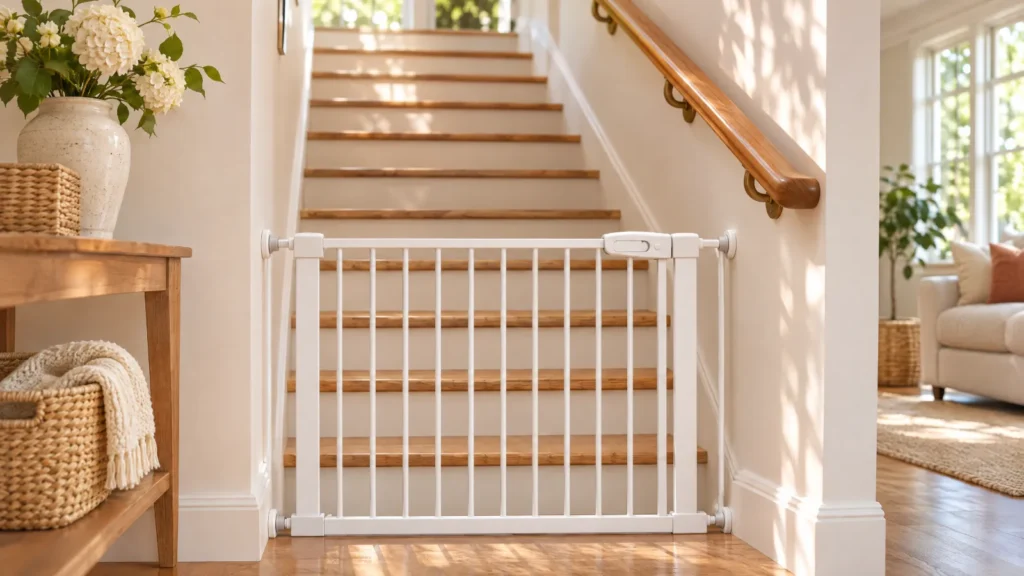
| Stairs and off-limits rooms | Safety gates; door knob covers | Only wall-screwed gates at the top of stairs |
| Medicines, detergent, cleaners, lighters | Safety latches and locks | Child-resistant packaging is not childproof |
| Hot tap water | Water heater setting; anti-scald devices | 120 degrees Fahrenheit or lower |
| Pools and spas | Barriers, self-latching gates, alarms, covers | Put barriers back after every use |
| Outlets | Outlet covers or tamper-resistant receptacles | Covers too big to choke on and hard to remove |

What should you buy before the weekend?
Walk the house first, then shop once from this list. Buy only what fixes a hazard you actually found.
- Furniture and TV anchor kits, one per tall or top-heavy piece
- An anti-tip bracket for a free-standing range, if yours is missing one
- Cabinet and drawer latches or locks
- Hardware-mounted safety gates for the top of stairs, labeled as meeting current standards
- Door knob covers for garage, laundry and bathroom doors
- Window guards or safety netting, and cordless shades where cords hang
- Outlet covers sized so they cannot be swallowed
- Smoke and carbon monoxide alarms, or fresh batteries
- A stud finder, drill, screwdriver set and safety glasses
We do not have sourced prices for this gear, so instead of a price range, here is what moves your total.
| What drives the cost | Why it matters |
|---|---|
| Number of tall or top-heavy pieces | Each one needs its own anchor kit |
| Stairways and doorways to block | Each stair top needs its own wall-mounted gate, and each off-limits door its own cover |
| Corded window coverings | Replacing them with cordless ones is the safest fix, and the count adds up across many windows |
| Upper-floor windows | Guards or netting for each window a child can reach |
| Pool or spa | Barriers, alarms and covers are several separate items, and code work may need a pro |
| Outlet replacement | Tamper-resistant receptacles mean an electrician’s visit |
How do you stop furniture and TVs from tipping over?
Anchor them. The CPSC tip-over release from February 2026 reports 217 tip-over deaths from 2013 through mid-2023, and says 44% of the people treated for tip-over injuries in 2020 to 2022 were under 18. Its advice is to anchor TVs and furniture such as bookcases and dressers securely to the wall.
If a TV cannot be anchored, the same release says to set it on a sturdy, low base, push it as far back as it will go and keep cords out of reach. Keep toys and remotes off high shelves where a child might climb for them, and put heavier items low. On a free-standing range, the CPSC childproofing guide calls for an anti-tip bracket, because a range that tips can crush or scald a child.
Use the restraint hardware that came with the furniture where you can, and drive screws into studs or the anchors your wall type calls for. Our basic home tool kit lists the basic tools for the job.
What should you do about windows and window cords?
Cords come first. The CPSC window covering safety center says cordless coverings are the only option that eliminates the strangulation hazard and the safest choice when young children are around. If you cannot replace corded coverings yet, shorten pull cords, add cord stops and anchor continuous-loop cords. The CPSC is plain that those steps only reduce the hazard.
Move cribs, beds, furniture and toys away from windows and cords, ideally to another wall, so a child cannot climb within reach. That single move also cuts the risk of window falls. The CPSC childproofing guide says screens are not effective at keeping children in, and recommends window guards or safety netting that limit openings to 4 inches or less. Keep at least one window in each room usable as a fire escape.
Which gates and door covers work where?
Door knob covers keep children out of garages, laundry rooms and bathrooms. The CPSC adds one condition: an adult must still be able to open the door fast in an emergency. Try it yourself with both hands full before you count on it.
How should you store medicines, cleaners and pest products?
Up high and behind a latch or lock, every time. The CPSC guide covers medicines, laundry detergent, cleaners, matches, lighters and knives, and it warns that child-resistant packaging is not childproof. Keep products in their original labeled containers.
Pest products deserve the same treatment. Better yet, cut the need for them by sealing food, fixing leaks and closing gaps, the prevention-first approach in our guide to pest control strategies and the EPA IPM approach.
How do you prevent burns and drowning?
Set the water heater to 120 degrees Fahrenheit or lower, as the CPSC childproofing guide advises, and consider anti-scald devices on faucets and shower heads. Stay with a child for every minute of every bath. A young child can drown in moments.
With a pool or spa, the CPSC lists layers that work together: self-closing and self-latching gates, fences that separate the pool from the house, door alarms, pool alarms and power safety covers. A barrier only works when it is closed, so put it back after every use, including the moment guests leave.
What about outlets, smoke alarms and CO alarms?
Outlet covers should be hard for a child to pull off and too large to choke on. When you replace outlets, the CPSC suggests tamper-resistant receptacles. Swapping receptacles is electrical work, so hire a licensed electrician unless you know the job well, and check whether the work needs a permit where you live.
The CPSC childproofing guide also calls for smoke alarms on every level, inside each bedroom and outside sleeping areas, and carbon monoxide alarms outside bedrooms near each sleeping area, even in homes without fuel-burning appliances. Test them monthly and change batteries at least once a year, or use sealed 10-year smoke alarm batteries. If you are also weighing monitored sensors, our guide to choosing a home security system explains what they add and what they do not replace.
How should you split the work across one weekend?
| Block | Focus | Output |
|---|---|---|
| Saturday morning | Walk every room on your knees at a toddler’s eye level | A written hazard list, ranked by severity |
| Saturday afternoon | Anchors for furniture, TVs and the range | Tip-over risks handled |
| Sunday morning | Cords, window guards, gates and door covers | Strangulation, window and stair risks handled |
| Sunday afternoon | Latches, storage, water heater setting, alarms | Poison, burn and alarm checks done |
| Sunday evening | Review the list and book a pro for anything you could not do safely | A follow-up plan with dates |
A budget helps you shop once. Say your walkthrough finds five pieces of furniture to anchor, eight cabinet doors to latch and two stairways to gate. With placeholder prices of $10 per anchor kit, $3 per latch and $40 per wall-mounted gate, the list comes to $50 plus $24 plus $80, or $154. Those prices are made up for the arithmetic, so swap in real ones from your store.
Where do weekend childproofing projects go wrong?
Hand-me-downs are the first trap. Search the CPSC recall database before you use a secondhand crib, gate or window covering; the same page explains how to report an unsafe product. The second is the wrong gate in the wrong place. A pressure gate at the top of the stairs, or a pet gate anywhere a child plays, defeats the point.
Hardware fails quietly too. Stick-on latches and bumpers can let go on textured, damp or dusty surfaces, so clean the spot and test the grip. A strap screwed only into drywall may not hold a dresser with a child climbing it, so find the stud or use the anchor the kit specifies. And none of this is set and forget. Children grow, climb higher and figure out latches, so walk the house again every few months.
When should you hire help, and how do you vet it?
The FTC’s guide on how to avoid a home improvement scam gives a short vetting list. Consider only licensed and insured contractors, confirm the license with your state or county, get written estimates and do not pay the full amount up front. If you sign a contract at home, it should include a written statement of your right to cancel within three business days.
From years of marketing home services, I have watched “free safety assessments” used mostly as a way through the front door to sell a bigger job. Take the written estimate, hold it up against the CPSC list above, and buy only what fixes a hazard you actually found.
What should you do this weekend?
- Walk the house at a child’s eye level. Write down everything that could tip, every cord, every reachable chemical and every open drop.
- Anchor furniture, TVs and the range first, using wall anchors and the range’s anti-tip bracket.
- Deal with cords and windows. Go cordless where you can, move cribs and beds away from windows and add guards that limit openings to 4 inches.
- Gate the stairs correctly. Wall-screwed gates at the top, and no V-shaped accordion gates.
- Lock up poisons. Latch cabinets, keep products in labeled containers and save the Poison Control number.
- Check water and alarms. Set the water heater to 120 degrees or lower and test smoke and CO alarms.
- Check recalls and book the pro jobs. Search secondhand items on the CPSC recall site and schedule licensed help for wiring or pool work.
Frequently asked questions
What are the most important childproofing steps?
Start with the hazards behind the most serious injuries: anchor furniture and TVs, remove or secure window covering cords, gate stairs with wall-screwed gates at the top, and lock up medicines and cleaners. Then set the water heater to 120 degrees Fahrenheit or lower and check smoke and CO alarms.
Can I use a pressure-mounted gate at the top of the stairs?
No. The CPSC says to use only gates that screw into the wall at the top of stairs, and never to use pet gates for children. Use a pressure-mounted gate only where its maker’s label allows it, never at the top of stairs.
Are cord stops and cleats enough for corded blinds?
They help, but the CPSC says they only reduce the strangulation hazard. Cordless window coverings are the only option that eliminates it and the safest choice when young children are in the home.
Is child-resistant packaging enough to keep kids out of medicine?
No. The CPSC warns that child-resistant packaging is not childproof. Store medicines and cleaners up high behind a latch or lock, and keep the Poison Control number, (800) 222-1222, handy.
How does childproofing differ from senior-proofing?
Childproofing keeps young children away from hazards they cannot recognize, while senior-proofing lowers fall risk for older adults. They share clear floors and good lighting, but some fixes, such as stair gates, can create trip hazards for an older adult, so plan each one with the whole household in mind.