
There is no national price for a home solar system, so your cost is the written quote for your roof. Payback depends on your electricity use, your rate and how your utility credits power you send back. The U.S. average residential price was 18.17 cents per kWh in September 2026, and the 30 percent federal 25D credit no longer applies to new systems.
That last part trips people up. Say a salesperson at your door this winter hands you a glossy proposal with a big “30% tax credit” line near the bottom. The IRS says the residential clean energy credit is not allowed for expenditures made after December 31, 2025, and an expenditure counts as made when original installation is completed. A deposit or full payment in 2025 does not save the credit for a system finished in 2026. Any 2026 proposal that subtracts 30 percent is built on old math.
What exactly ended with the federal solar tax credit?
The residential clean energy credit (section 25D) paid 30 percent of qualified costs for property placed in service from 2022 through 2025, according to the 2025 Instructions for Form 5695. Public Law 119-21, dated July 4, 2025, set its end date. The IRS credit page now says the credit is not available for any property placed in service after December 31, 2025.
Three things did not end. The credit was nonrefundable, and the IRS says unused credit can carry forward to later years, so a system installed in 2025 or earlier can still show up on a 2026 return. Anyone reviewing an older job still needs the old rules. And state, local and utility programs are separate from the federal credit and were not changed by it.
For those older jobs, the main 25D rules, per the IRS, were these. Qualified property included solar electric panels, solar water heaters, small wind, geothermal heat pumps, fuel cells and, from 2023, battery storage of at least 3 kilowatt-hours. Labor for onsite preparation, assembly, original installation and the wiring to connect the system could count. Ordinary roofing that only holds panels up generally did not qualify, though solar tiles and shingles could. Used equipment did not qualify, a landlord who did not live in the home could not claim it, and the credit was claimed on Form 5695 for the year the system was installed, not the year it was bought.
Here is how the cutoff plays out between two neighbors who each paid $20,000 for the same system. The figures are for illustration only, not a typical U.S. price.
| Neighbor A | Neighbor B | |
|---|---|---|
| Installation completed | December 2025 | January 2026 |
| 25D credit at 30 percent | $6,000 | $0 |
| Net cost after credit | $14,000 | $20,000 |
| Amount added to basis, if treated as an improvement | $14,000 ($20,000 minus the $6,000 credit) | $20,000 |
The basis line comes from IRS Publication 523, which says improvements that add value increase basis and that energy credits must be subtracted from it. A larger basis only lowers tax on a future sale, so it is a small offset, not a stand-in for the lost credit. A tax professional can confirm how your own system is treated.
What should a solar quote include?
The FTC advises comparing detailed bids from several companies, each stating the system size, the full installation cost and the warranties. Ask every company the same questions so the totals compare fairly. Each line below is also a place where the price moves.
| Quote item | What to look for |
|---|---|
| System size (kW DC) | The rated output of the panels. It should be sized from your last 12 months of utility bills, not a standard package. |
| Estimated annual production (kWh) | The installer’s estimate for your roof. This number drives every savings claim in the proposal. |
| Equipment list | Panel and inverter make and model, plus any battery as its own line item. |
| Roof and electrical work | Any roof repair, reroofing or electrical panel upgrade the job needs, priced separately. |
| Permits and interconnection | Who files for permits, inspections and utility approval to connect, and whether those fees are included. |
| Warranties | Separate terms for panels, inverter and workmanship, and who honors them if the installer closes. |
| Payment type | Cash, loan, lease or power purchase agreement, with every monthly figure and any yearly increase in writing. |
The FTC also suggests asking whether the company holds the licenses, certificates or bonding your state, county and city require. Grid-tied systems involve wiring and utility approval, so check our guide to permits for home projects.

Is your house a good fit for solar?
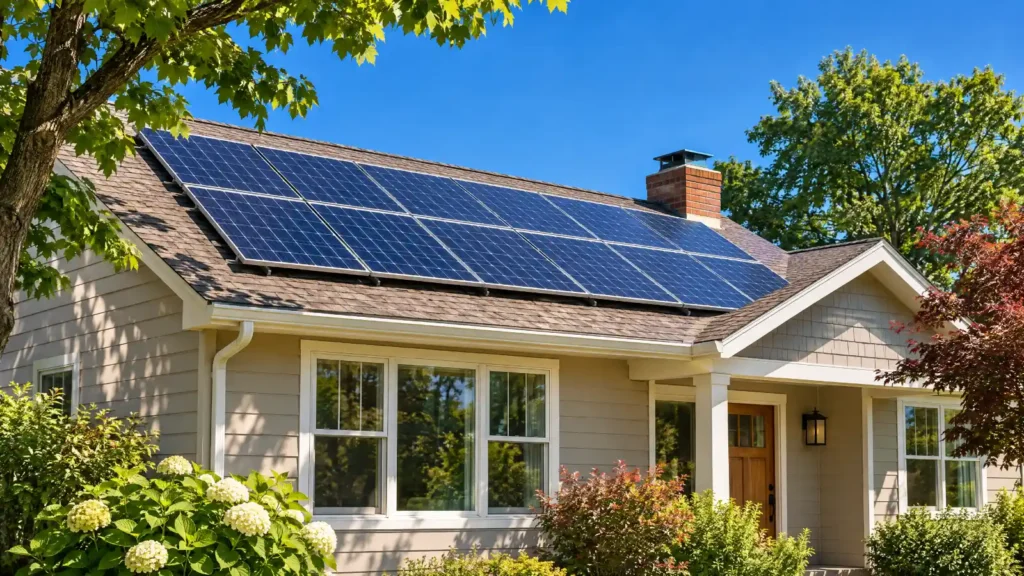
The DOE’s Homeowner’s Guide to Going Solar says there is no universal solar solution. Its savings article lists what decides the fit. Trees that shade the roof can rule out rooftop panels. Panels typically perform best on south-facing roofs, with southeast to southwest orientations and slopes of 15 to 40 degrees named as workable.
Roof size and shape matter, and so does the roof’s remaining life. Panels sit up there for many years, so a roof near the end of its life is worth settling first. Our guides on spotting a worn-out roof and deciding between roof repair and replacement cover what to check. Ask each installer what removing and reinstalling the panels would cost later.
How do you estimate solar payback?
The DOE’s method is simple: subtract upfront incentives from the system cost, then divide by your yearly savings. The hard part is the savings number. It depends on how much power you use, your rate and how your utility pays for power you send back to the grid, which DOE notes differs by utility.
Take a $20,000 system that offsets 8,800 kWh a year, with every kWh valued at the September 2026 U.S. average residential price of 18.17 cents. Then change one assumption: half the power is used at home and half is exported and credited at 9 cents. The system price, output and export rate are made up to show the math, not typical figures.
| Scenario | Yearly savings | Net cost | Payback |
|---|---|---|---|
| All 8,800 kWh worth 18.17 cents, 2026 (no credit) | About $1,599 | $20,000 | About 12.5 years |
| Same system under the old 30 percent credit | About $1,599 | $14,000 | About 8.8 years |
| Half used at 18.17 cents, half exported at 9 cents | About $1,195 ($799 plus $396) | $20,000 | About 16.7 years |
The export rule matters as much as the panel price. So does your usage: low use leaves less of the bill to offset, and a system sized beyond your use only pays off if exports are credited well. Ask your utility, not the installer, how it credits exported power today and whether that can change. Financing cost comes straight out of the savings, so run the math on the monthly payment, not just the cash price.
Rates move, too. The EIA figure above was up 0.7 percent from September 2025. The FTC cautions against any company that promises savings without accounting for future utility rate changes, since those rates are hard to predict.
Buying, leasing or a power purchase agreement: what do you gain and give up?
The FTC explains the three main paths. When you buy, you pay the full cost at installation, with cash or a loan. With a lease, a company installs the system and you sign a long-term contract to use it. With a power purchase agreement (PPA), you pay for the power the system produces rather than for the system itself.
| Path | What you gain | What you give up | Questions to ask |
|---|---|---|---|
| Buy with cash | You own the system and keep all bill savings after payback | A large sum leaves your savings | What do warranties cover, and who services the system? |
| Buy with a loan | Ownership without paying all at once | Interest reduces savings, and some loans are secured by the home | What is the APR, the term and the total of all payments? |
| Lease | Little or no upfront cost, and the company usually handles maintenance | You do not own the equipment, and the contract can complicate a home sale | Do payments rise each year, and by how much? |
| PPA | You pay only for power produced | You do not automatically get all the power it produces, and terms run for years | What is the price per kWh, and does it escalate? |
| Wait | Time to fix the roof, cut usage or check local programs | Bill savings you might have earned meanwhile | Is there a roof or electrical problem to fix first? |
For leases and PPAs, the FTC suggests asking whether payments will increase and by how much, whether you can move the system or transfer the contract if you sell, and whether a buyer would have to meet credit requirements or pay fees to take it over. For PACE financing, ask whether a lien will be placed on your home, because the FTC warns it can affect your ability to refinance or sell. Our guide to financing a home project compares other ways to pay.
Do batteries change the cost math?
A battery adds equipment and installation cost, so ask for it as its own line. The DOE savings article describes solar plus storage as adding resilience during outages but gives no general battery savings figure. Decide whether outage backup or bill savings is the real goal. No new federal credit applies to batteries installed in 2026.
Do DOE or state rebates help pay for solar?
Not the DOE Home Energy Rebates, as listed. The DOE program page says HOMES pays up to $8,000 for whole-home projects based on modeled savings of at least 20 percent, and HEEHR pays up to $14,000 for upgrades such as insulation, air sealing, ventilation, wiring and electric heating and cooling. Solar panels are not on either list, and both run only in select states.
State and utility solar programs are separate and change often. Ask your state energy office and your electric utility what applies at your address, and see our guide to energy rebate eligibility for how to read program rules.
How is solar marketed, and where do the ads overpromise?
I have spent 18 years in finance and insurance performance marketing, and solar is one of the categories where ad copy outlives the rules it describes. Headlines about a 30 percent federal credit or a free government solar program can keep running after the credit ends, simply because nobody updated the ad.
“Zero down” and “free panels” usually lead to a phone call where the real financing terms come out, so the number in the ad is rarely the number in the contract. The FTC says to avoid any company that pressures you for a quick decision, asks you to sign without time to review the contract, or asks to be paid in cash.
Before you sign a solar contract
- Remove the federal credit from every 2026 proposal. Recalculate payback without it, using the DOE formula.
- Settle the roof first. Have its remaining life checked by someone who is not selling panels.
- Pull 12 months of utility bills. Size the system from real usage, and ask your utility how it credits exported power today.
- Get several detailed bids. Each should list system size, estimated production, full installed cost, equipment and warranties.
- Verify licenses and bonding. Ask what your state, county and city require, and confirm it.
- Read every payment term. For loans, check APR and total cost. For leases and PPAs, check escalators, transfer rules and any lien.
- Take your time. Do not sign the same day, and do not pay in cash.
Frequently asked questions
Can I still get the 30 percent federal solar tax credit?
Not for a new system. The IRS says the 25D credit is not allowed for expenditures made after December 31, 2025, and an expenditure counts as made when installation is completed, so paying early does not save it. Unused credit from a system installed in an earlier year can still carry forward.
Is there a national average cost for solar panels?
No federal source publishes one for 2026. Your cost is the written quote for your house, and DOE says savings depend on shade, roof direction and slope, usage, rates and how your utility credits exported power.
How do I calculate solar payback?
DOE’s method is to subtract upfront incentives from the system cost and divide by your yearly bill savings. In the hypothetical example above, a $20,000 system saving about $1,599 a year pays back in about 12.5 years, and lower export credits push that out.
Is leasing solar panels a good idea?
It depends on the contract. A lease or PPA means little or no upfront cost, but you do not own the system, payments may rise each year, and the FTC suggests asking how the contract transfers if you sell the house.
Do DOE Home Energy Rebates pay for solar panels?
The DOE page lists insulation, air sealing, ventilation, wiring, heating and cooling equipment and appliances, not solar panels. HOMES pays up to $8,000 and HEEHR up to $14,000, only in select states.
Should I replace my roof before installing solar?
If the roof is near the end of its life, settle that first. Panels stay up for many years, and removing and reinstalling them for a later roof job adds cost.

Tier 1 Sources
- IRS: FAQs on sections 25C, 25D and others under Public Law 119-21 (FS-2025-05)
- IRS: Residential Clean Energy Credit
- IRS: Instructions for Form 5695 (2025)
- IRS: Publication 523, Selling Your Home
- U.S. Department of Energy: Homeowner’s Guide to Going Solar
- U.S. Department of Energy: Will I Save Money with Solar Energy?
- U.S. Energy Information Administration: Electricity Monthly Update, end-use prices
- FTC: Solar Power for Your Home
- U.S. Department of Energy: Home Energy Rebates Program