
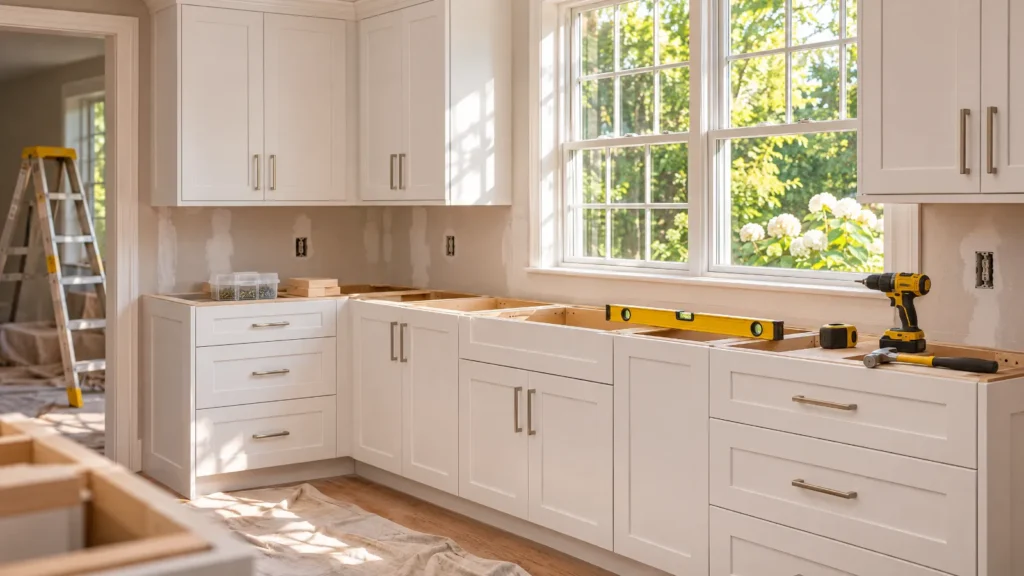
A kitchen remodel goes best in a set order: fix what is failing, build the budget from written bids rather than ads, and hire a licensed, insured contractor under a detailed written contract. For scale, the median reported spending on kitchen remodels done from 2021 to 2023 was $8,000, according to the Census Bureau’s 2023 American Housing Survey.
That median lumps new drawer pulls together with full gut jobs, so use it as a gut check, not a quote. If you are planning around the holidays, start the clock with demolition, not with the showroom visit. A kitchen that is torn out in November and waiting on a countertop in December is a long month of takeout.
What should you fix before you choose finishes?
Fix anything failing or unsafe first. New cabinets hung over a slow leak or tired wiring will have to come down again. Before you look at a single sample, walk the room with a flashlight and a notepad.
Look under the sink and around the dishwasher for stains, a soft cabinet floor or a musty smell. Note outlets that feel warm, breakers that trip when two appliances run, and anything living on an extension cord. Check whether the range hood actually vents outdoors or only recirculates. Gaps around pipes and behind appliances let pests in, and they are easiest to seal while cabinets are out. If new flooring is part of the plan, see how to pick laminate planks before you buy.
Safety belongs in the plan from day one, because the kitchen is where most home fires start. The U.S. Fire Administration says cooking is by far the leading cause of home fires and home fire injuries. In 2021, fire departments responded to an estimated 170,000 home cooking fires, which caused about 135 deaths and 3,000 injuries.
How do you set a realistic kitchen budget?
Pick the scope before you pick the number. Most kitchen projects land in one of three tiers, and each trades cost and disruption against how much the room changes.
| Scope | Typical work | What you gain | What you give up |
|---|---|---|---|
| Refresh | Paint, hardware, lighting, faucet, backsplash | Lower cost, the kitchen stays usable | Layout and storage stay the same |
| Replace in place | New cabinets, counters and appliances in the same footprint | A new look without moving plumbing or gas | Weeks without a working kitchen |
| Layout change | Moving the sink, range or walls; new circuits | Fixes how the room works | Permits, more trades, the longest timeline and highest cost |
With a tier chosen, get written bids and read the allowances closely. An allowance is a placeholder for something you have not picked yet. Kitchens carry several at once, for cabinets, counters, tile, fixtures and appliances, and every one of them can grow once you choose a real product.
Say your contract is $30,000, with a $6,000 cabinet allowance and a $3,000 countertop allowance. These are made-up figures to show the math. You fall for cabinets at $7,800 and a counter at $3,600. That is $1,800 plus $600, or $2,400, which adds 8 percent to the contract before anyone opens a wall.
A 10 percent contingency that you hold yourself, $3,000 here, would absorb those upgrades and leave $600 for everything else. In an older house where walls will come open, plan a bigger cushion. Our cost estimate worksheet lines up bids and allowances side by side.
We have one sourced national number, the Census median above, and no reliable low, typical and high range to publish. So instead of a price table, here is what moves your bid up or down.
| What drives the cost | Keeps it lower | Pushes it higher |
|---|---|---|
| Layout | Sink, range and fridge stay put | Moving plumbing, gas or walls |
| Cabinets and counters | Choices inside the allowance | Upgrades past the allowance |
| Electrical | Existing circuits handle the appliances | New circuits, a gas-to-induction switch, panel work |
| House age | Built after 1978, sound wiring | Lead-safe work rules, old wiring, hidden rot |
| Permits | Cosmetic work that needs none | Permits and inspections for plumbing, gas, circuits or walls |
| Financing | Paying from savings | Interest and a lender’s timeline |

Which safety details should the plan include?
A remodel is the cheapest moment to build safety in, because the walls and cabinets are already open. Take these to your designer or contractor as questions.
Where does the smoke alarm go? The U.S. Fire Administration suggests placing smoke detectors about 10 feet from the stove, so normal cooking does not set them off and tempt someone to pull the battery. Are there enough circuits? The USFA advises against running kitchen appliances on extension cords, so plan outlets and circuits for the appliances you actually use. What sits near the range? Keep anything that can burn away from the cooktop, which affects where open shelves, towel bars and curtains go. Can everyday items be reached? Put them between hip and shoulder height so nobody needs a step stool.
How should you compare new appliances?
Read the yellow EnergyGuide label before you compare prices. The FTC’s Appliance Labeling Rule requires most major home appliances to carry one, and the label shows the highest and lowest energy estimates for similar models, so you can see where a model sits in its class.
Then measure. Counter depth, door swing and the walk from the fridge to the sink shape your day more than any feature list. Switching from gas to an electric or induction range may also need a new circuit, which belongs in the electrician’s bid and not on delivery day.
Some states offer rebates on efficient electric appliances and wiring through federally funded programs, but only in select states. Our guide on whether your home qualifies for energy upgrade rebates explains how to check with your state energy office before you count on one.
What if your house was built before 1978?
Older kitchens often hide lead-based paint under newer coats. The EPA’s Renovation, Repair and Painting Rule covers paid work that disturbs paint in housing built before 1978. It applies when the work disturbs more than six square feet of painted surface per room inside, or more than 20 square feet outside.
For covered work, the firm must be EPA certified and trained in lead-safe practices, and the EPA says no firm may offer or perform covered renovations without that certification. Ask to see it before you sign, and look for containment and cleanup steps in the bid. Pulling out cabinets and soffits in an older kitchen clears the six-square-foot mark fast.
Will a kitchen remodel need a permit?
That depends on the work and your local rules. Paint and hardware often need nothing. Moving plumbing, adding circuits, running a new gas line or taking out a wall commonly does. Your city or county building department decides, and our guide on checking permit rules shows what to ask.
Write permit responsibility into the contract. The FTC’s home improvement scam guidance lists a contractor who asks you to get the required building permits as a warning sign.
How do you hire a kitchen contractor and sign safely?
- Vet first. The FTC says to consider only licensed and insured contractors, confirm the license with your state or county, and ask for proof of insurance. Search the company name with words like complaint or review.
- Get several written estimates. Each should describe the work, materials, completion date and price. Hand every bidder the same scope sheet.
- Question the outlier. The FTC advises against automatically taking the lowest bid and suggests asking why when bids differ widely.
- Get a full written contract. It should list the contractor’s name, address, phone and license number, start and finish dates, any spoken promises about scope and cost, your right to cancel within three business days if you signed at home, and no blank spaces.
- Keep payments behind the work. The FTC says not to pay the full cost up front, notes that some states cap down payments, and says to hold the final payment until the job is done and you are satisfied.
- Shop financing on your own. The FTC warns against taking contractor-arranged financing without comparing other lenders. Our guide to home improvement loans and HELOCs lays out the options.
How are kitchen remodels marketed?
Kitchen and appliance ads like to lead with a low monthly payment and keep the total vague until someone is in your living room. I have run lead generation for home services, and that framing is chosen because it books appointments, not because it tells you what the project costs.
Get the total contract price, the loan term and the rate type in writing before you compare offers. And know that one online quote form can send your details to several contractors at once, so expect more than one call.
Which kitchen jobs can you do yourself?
Painting walls, swapping cabinet hardware, adding plug-in under-cabinet lights and sealing gaps around pipes are fair weekend jobs for many owners. Our list of simple DIY home improvement projects has more ideas and the safety gear to use.
For a hardware-and-paint refresh, the shopping list is short:
- New pulls or knobs, measured hole to hole against the old ones
- A drill and driver, plus a drilling template if the new hardware does not match the old holes
- Painter’s tape, drop cloths, a roller, an angled brush and paint suited to kitchens
- Caulk and a caulk gun for gaps around pipes and the backsplash edge
- Plug-in or battery under-cabinet lights, so no new wiring is needed
- A short, sturdy stepladder
Which records should you keep?
Save the contract, change orders, invoices and proof of payment. IRS Publication 523, written for 2025 returns, lists kitchen modernization and built-in appliances among improvements that can add to your home’s basis. Repairs and maintenance, like repainting or fixing a leak, generally do not, unless they are part of an extensive remodel. How basis applies when you sell is a question for a tax professional.
What changes the plan for your kitchen?
Demolition is where plans meet reality. Rot, leaks or old wiring found behind the cabinets move money from finishes to repairs. A pre-1978 house adds lead-safe rules, and its wiring may not carry new appliances. Moving plumbing or gas brings permits, more trades and more weeks.
Two personal questions matter as much. If you borrow, interest and a lender’s timeline become part of the project. And if you expect to sell soon, a refresh may fit better than a full remodel, since buyers in your area, not a national average, decide what a new kitchen is worth.
Frequently asked questions
How much does a kitchen remodel cost?
It varies widely with scope, house and region. The Census Bureau’s 2023 American Housing Survey reported a median of $8,000 for kitchen remodels done from 2021 to 2023, but that figure mixes small refreshes with full renovations. Written bids for your own scope are the only reliable number.
What should I fix first in a kitchen remodel?
Fix leaks, unsafe wiring, gas issues and ventilation problems before finishes. New cabinets over a slow leak or overloaded circuit may have to come out again.
Do I need a lead-safe contractor for my kitchen?
If the house was built before 1978 and paid work will disturb more than six square feet of painted surface per room inside, the EPA’s Renovation, Repair and Painting Rule requires an EPA-certified firm using lead-safe work practices.
Does a kitchen remodel need a permit?
Often, when the work moves plumbing, adds circuits, changes gas lines or removes walls. Paint and hardware usually do not. Your local building department decides, and the contract should say who pulls the permit.
How much should I pay a kitchen contractor up front?
The FTC says not to pay the full cost up front and notes that some states limit down payments. Tie payments to completed stages and hold the final payment until the job is finished to your satisfaction.

Tier 1 Sources
- U.S. Census Bureau and HUD: 2023 American Housing Survey, Home Improvements
- U.S. Fire Administration (FEMA): Cooking Fire Safety
- CPSC: Free-Standing Kitchen Ranges
- FTC: EnergyGuide Labels
- EPA: Frequent Questions About the Renovation, Repair and Painting Rule
- FTC: How To Avoid a Home Improvement Scam
- IRS: Publication 523, Selling Your Home